

Why MMM practitioners prefer the word 'Contribution' rather than 'Attribution'
The subtle but critical difference between assigning credit and quantifying real impact in your marketing strategy


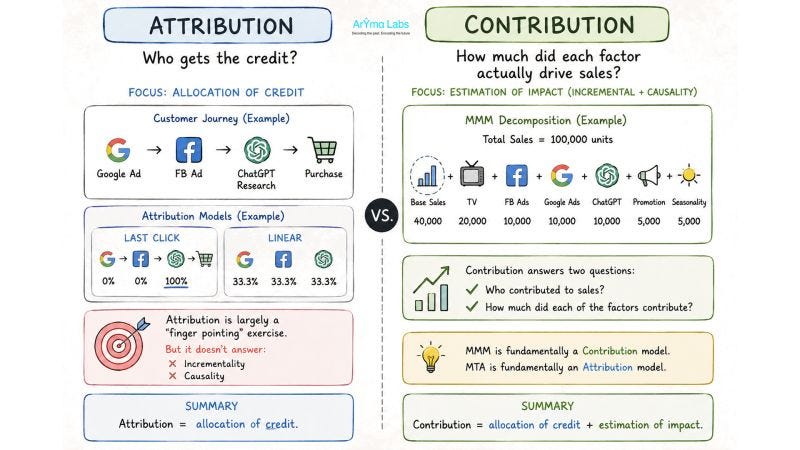
I have often noticed that Attribution and contribution are often used interchangeably in marketing measurement, but they are fundamentally different concepts.
Here is my POV:
Attribution is about who get's the credit
Attribution attempts to assign credit for a conversion or sale to specific marketing touchpoints.
For example:
let's take a customer journey:
Google ad -> FB ad -> ChatGPT research (yup this is happening nowadays) -> Purchase
A last click attribution model would say:
ChatGPT = 100% credit
A linear attribution model might say:
Google = 33.3%
Facebook = 33.3%
ChatGPT = 33.3%
Attribution hence is largely a 'finger pointing' exercise. But it doesn't answer two major things - Incrementality and Causality.
This bring me to Contribution.
Contribution
Contribution tries to estimate the incremental impact of a marketing activity on the outcome. And when done via MMM, it also helps answer the causality question to a certain extent.
Related post link in comments.
For example:
Suppose a brand sells 100,000 units.
MMM might estimate:
Base sales = 40,000 units
TV contribution = 20,000 units
FB Ads = 10,000 units
Google Ads = 10,000 units
ChatGPT = 10,000
Promotion = 5,000
Seasonality = 5,000 units
Contribution hence answers two questions:
"Who contributed to sales" and also "How much did each of the factors contribute"
That's why many MMM practitioners would argue that MMM is fundamentally a contribution model, while MTA is fundamentally an attribution model.
To summarize:
Attribution = allocation of credit.
Contribution = allocation of credit + estimation of impact.
Thanks for reading.
For help with MMM, Causal Marketing Experiments and Experimentation, get in touch with us.
We also build some pretty cool AI products to aid Marketing Measurements. Check out our products page to know more -
 | A guest post by
|