

Why Advanced Difference-in-Differences (DID) is better than SCM and ASCM in Real-World Marketing Experiments
DID is a more pragmatic and scalable solution for Marketing Experiments


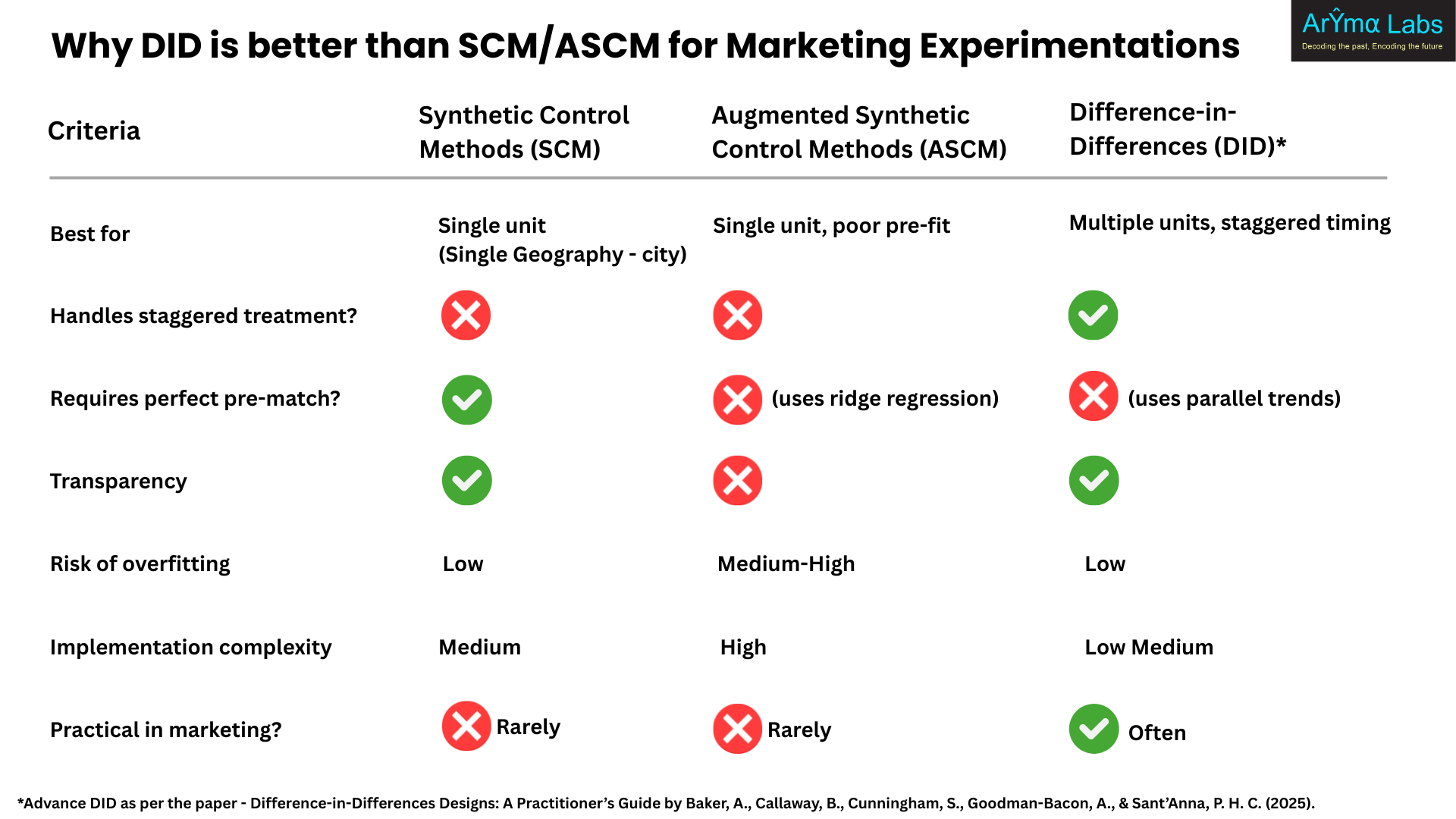
The new paper DID practitioner’s guide by Baker, Cunningham, Sant’ Anna, et al. has been making waves - and rightly so.
I finally had the chance to read the full paper last week, and here’s my take with respect to marketing application:
For real-world marketing experimentation, advanced DID is a far more practical and scalable choice than Synthetic Control (SCM) or Augmented Synthetic Control (ASCM).
For real-world marketing experimentation, advanced DID is a far more practical and scalable choice than Synthetic Control (SCM) or Augmented Synthetic Control (ASCM).
The No assumption myth for SCM/ASCM
Firstly let me address the myth that SCM/ASCM don't have assumptions like parallel trends.
SCM requires a "perfect synthetic twin" that mimics the treated unit’s pre-period exactly.
But ask yourself this - isn’t that just another (stricter) way of enforcing parallel trends?
In real-world marketing:
- Media mixes differ.
- Pre-periods are short or noisy.
- Customers behave differently across regions.
So, just like DID’s parallel trends, SCM "perfect twin" assumption is rarely met in practice.
What about Augmented Synthetic Control Method (ASCM)?
ASCM tries to solve the problem of bad pre treatment fit in SCM by using Ridge regression. However as they say - 'the cure must not be worse than the disease'.
Ridge regression ends up complicating and at times worsening the model further. Don't believe me. Ask anybody who fitted a penalized regression for MMM 😅.
Ridge regression almost always 'over corrects'.
So while Ridge was brought in to correct initial bias in the model, it further exacerbates the bias.
SCM, ASCM and DID - Relevance to Marketing
SCM and ASCM are built for single-unit treatment (e.g. one city, one region). That’s great for pilot tests.
But marketing doesn’t work that way:
▪️Marketing Campaigns roll out across multiple markets.
▪️Marketing Spend starts at different times.
▪️Effects are heterogeneous and staggered.
SCM/ASCM can’t handle that complexity.
Why Advance DID wins
The modern DID framework is:
✅ Built for multiple treated units (think multiple Geo's)
✅ Designed to handle staggered adoption (campaigns starting at different times)
✅ Doesn’t need synthetic twins - just the more flexible parallel trends assumption
✅ Scales well and easy interpretation
Our Practice at Aryma Labs
Last year, we pioneered the use of DID for MMM validation
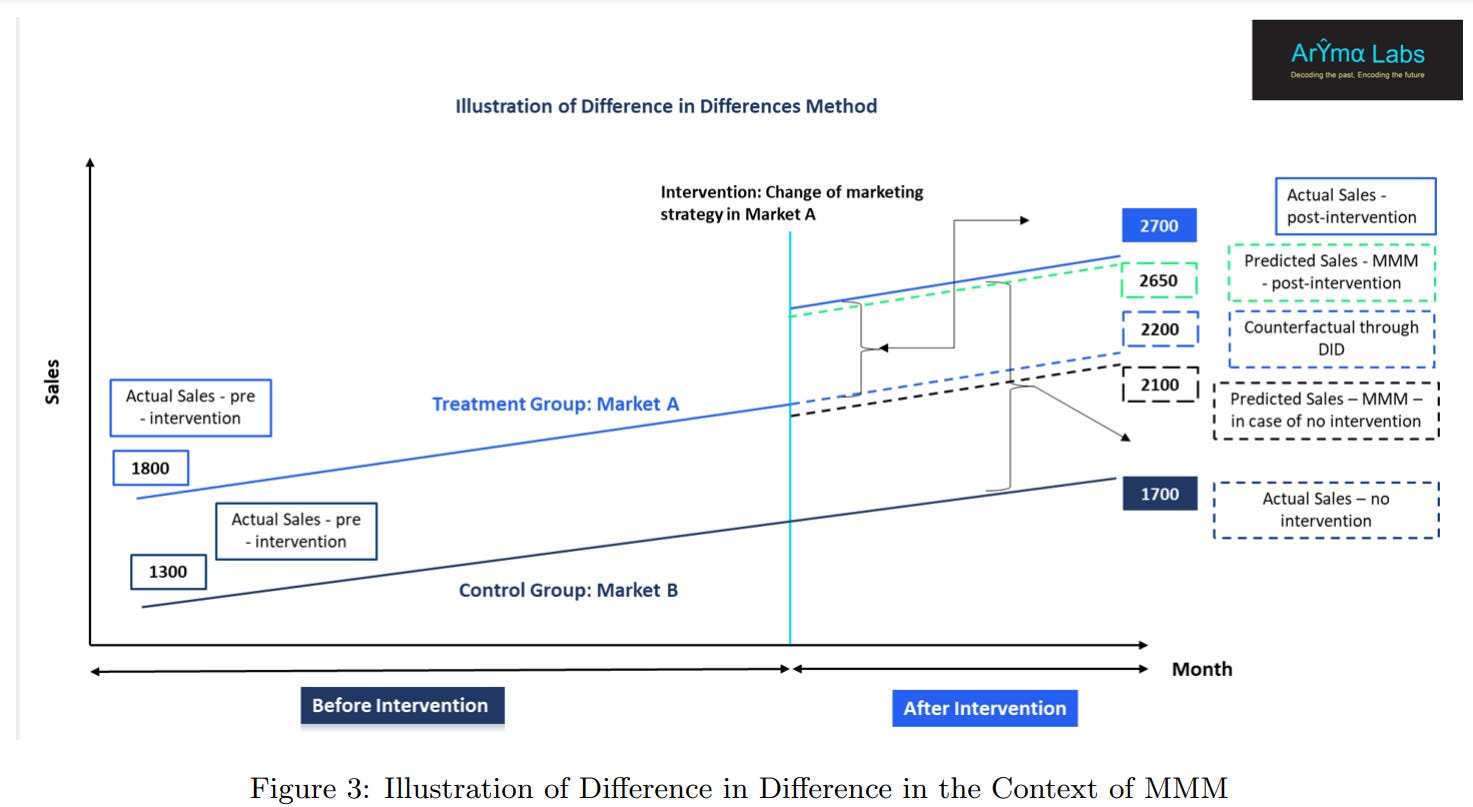
Going forward we will use Advance DID for:
- Standalone geo-lift experiments
- Campaign calibrations
- And even bettering our earlier DID for MMM implementation (addendum in the paper soon)
That said SCM/ASCM still have their place. They are good for controlled pilots in clean data settings.
But when it comes to scaling causal inference across geographies, DID is the way forward.
We will be covering all three SCM, ASCM, and DID in our upcoming Causal Inference for Marketing course. Stay tuned.
Thanks for reading.
Want help running marketing causal experiments accurately ? Reach out to us
 | A guest post by
|