

Is objective function optimization the right approach in Marketing Mix Modeling (MMM)?
Why chasing complete automation may be steering MMM away from uncovering the true causal impact of marketing variables


A lot of technical discussion that should be had in Marketing Measurement is never had.
One such question is "Why MMM can't be fully automated?"
We already wrote a post on why.
But When I started to think more deeply, I found another reason.
📌 Objective Function
An objective function is a mathematical function that defines the goal of an optimization problem. It represents the single metric you are trying to either maximize or minimize by adjusting specific input variables.
📌 Why is this a problem for MMM?
In MMM, our primary goal is to hunt for the absolute ground truth - Which variables affected my KPI and by how much?
The moment optimization enters, MMM stops being only about explaining "what happened?" and starts becoming about exploring "what all ways this could happen?"
📌 OLS is also a objective function, No?
Yes, unfortunately we humans have not found a perfect causal set up via regression methods. No matter how many variables you control for, if you have a regression set up, the purity of causal set up is never 100%.
Why?
Because you still have an inherent objective function - OLS.
OLS tries to minimize the squared error between your predicted data points and the ground truth. It does this globally (for all data points in the model).
Therefore, somewhere where a data point that should just be on the dot to the ground truth may get pulled away a little bit for the larger good (the overall goodness of fit - sum of squared errors).
So, we veer off a tiny bit from the actual ground truth/causality.
The above is why Quasi causal methods is considered less pure than perfect RCTs.
📌 Multi-objective Function
First of all, I want to laud the innovative thinking behind multi objective function approach in Robyn and other open source libraries.
It pushed the frontiers for MMM.
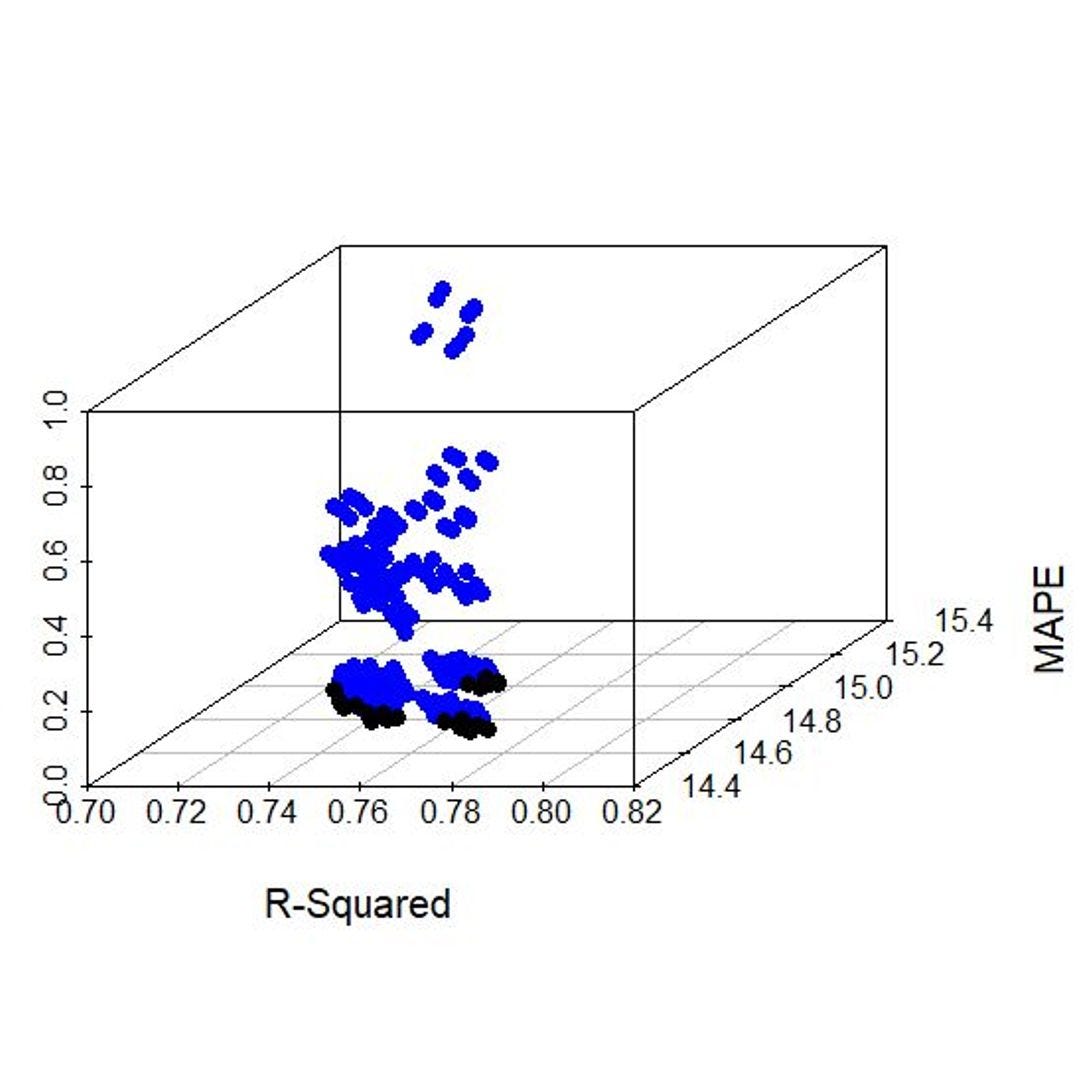 However some questions remain:
- How causal our models will be under a multi objective function set up?
I know some of you think MMM is correlational in nature. Statistically it is not but I will go with it for time being. I guess it is like a calling Twitter (X) a website.
Ok, so when we have an OLS set up, MMM is already not completely causal.
So here is my controversial take - An OLS model ('correlational') is much more likely to be causal and hence a good abstraction of reality as opposed to a OLS that is being optimized on more than one objective function.
An OLS model (’correlational’) is much more likely to be causal and hence a good abstraction of reality as opposed to a OLS that is being optimized on more than one objective function.
When we make any model set up multi-objective - things become a little bit more worse in terms of causal truth.
We even published a research paper 'Only two can tango at the pareto front'.
Your MMM is 'Ok' as long as you are optimizing on two objective functions.
But the moment you optimize on 3 objective functions, the model becomes worse.
We need a approach that somehow can satisfy objective function goal and also doesn't compromise on causal truth.
Till then, MMM can't be fully automated.
Thanks for reading.
For help with MMM, Causal Marketing Experiments and Experimentation, get in touch with us.
We also build some pretty cool AI products to aid Marketing Measurements. Check out our products page to know more -
 | A guest post by
|