

How to Validate The Interaction Terms in MMM (Beyond Just R-Squared)
Uncovering real synergies vs. noise with Likelihood Ratio Tests and why false interactions cost you more than you think


In my last post, I wrote about why one should add interaction effects and how many one can add.
In this post, I will cover how you can validate whether the Interaction terms you added are accurate or just inflating noise.
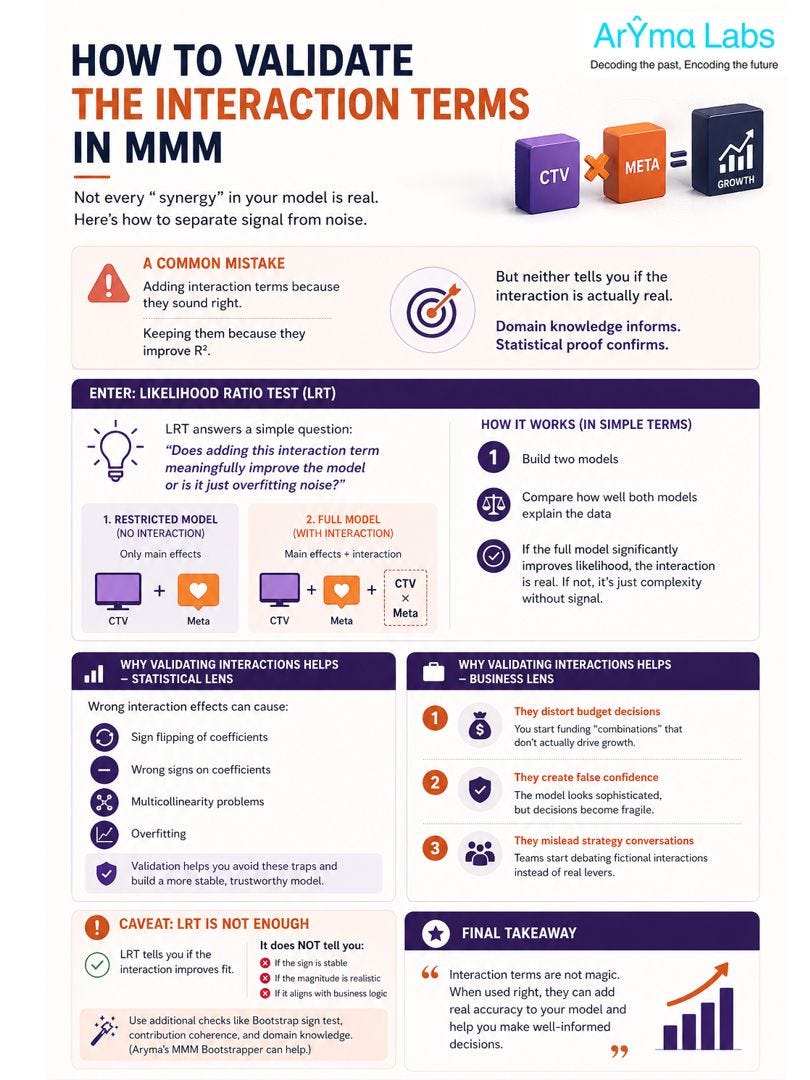
One of the most common mistakes in MMM is :
- Adding interaction terms because they sound right
- And then Keeping them because they improve R squared value !
But neither tells you if the interaction is actually real.
Yes domain knowledge can inform but statistical proof to go with it will be even better.
📌 Enter : Likelihood Ratio Test
At its core, the Likelihood Ratio Test (LRT) answers a simple question:
Does adding this interaction term meaningfully improve the model or is it just overfitting noise?
📌 How it works:
Lets take the example from last post:
Y = β1X1+ β2X2 + e
Assume the X's to be CTV and Meta
First, you build two models:
1. Restricted Model (No Interaction)
Only main effects
CTV + Meta
2. Full Model (With Interaction)
Main effects + interaction
CTV + Meta + (CTV × Meta)
Now we compare how well both models explain the data.
If the full model significantly improves likelihood, the interaction is doing real work.
If not, it is just adding complexity without signal.
I am purposely not going into the statistical nitty gritty - the statistic of LRT etc. But I will leave a link for anyone to read further in comments. But the above is the general idea of LRT.
📌 How validating Interaction Effects Helps - Statistical Lens
Wrong Interaction effects are notorious for causing
- Sign Flipping of coefficients
- Wrong signs itself on coefficients
- Multicollinearity problems
- Overfitting
Interaction Effects Validation helps in all these regards.
Caveat - Even LRT is not enough.
LRT tells you if the interaction improves fit
It does NOT tell you:
- If the sign is stable
- If the magnitude is realistic
- If it aligns with business logic
That’s where you need additional tests like Bootstrap sign test . We have our own MMM Bootstrapper tool for this. Also one must still use domain knowledge to check contribution coherence.
📌 How validating Interaction Effects Helps - Business Lens
Because false synergies are expensive.
1. They distort budget decisions
You start funding “combinations” that don’t actually drive growth
2. They create false confidence
The model looks sophisticated, but decisions become fragile
3. They mislead strategy conversations
Teams start debating fictional interactions instead of real levers
📌 Final Takeaway
Interaction terms are not magic. When used right they can really add accuracy to your model and help you make well informed decisions.
Thanks for reading.
For help with MMM, Causal Marketing Experiments and Experimentation, get in touch with us.
We also build some pretty cool AI products to aid Marketing Measurements. Check out our products page to know more -
 | A guest post by
|